Tags: astro, ai, wordpress, static, eleventy, hugo
How AI is Killing Simple WordPress Sites (And What to Use Instead)
WordPress powers 43% of the web. For a long time that made sense. It gave non-developers a way to build and manage websites without writing code, and it gave developers a fast path to a CMS without building one from scratch.
But a large chunk of those WordPress sites are brochure pages and blogs that change twice a year. They are running a plugin-bloated, database-dependent PHP application on shared hosting to serve what is essentially static content. The only reason to do that was accessibility - WordPress made it easy enough that anyone could set it up.
AI coding tools just removed that last reason.
What WordPress was actually solving
WordPress solved two problems really well:
- Templates - reusable layouts without writing every page by hand
- Content authoring - non-technical people could write and update pages without touching code
Both of those problems have better solutions in 2026, and AI is what makes them accessible to everyone.
AI changes who can build a custom site
The old trade-off was: you could have a clean, fast custom site, or you could have something a non-developer could maintain. You could not have both without significant investment.
AI breaks that trade-off. With tools like Claude Code, Cursor, or Windsurf, describing what you want produces working code. “Add a services section with four cards and icons” comes back as a real, clean component in seconds. You do not need to know how to code to get a codebase you own.
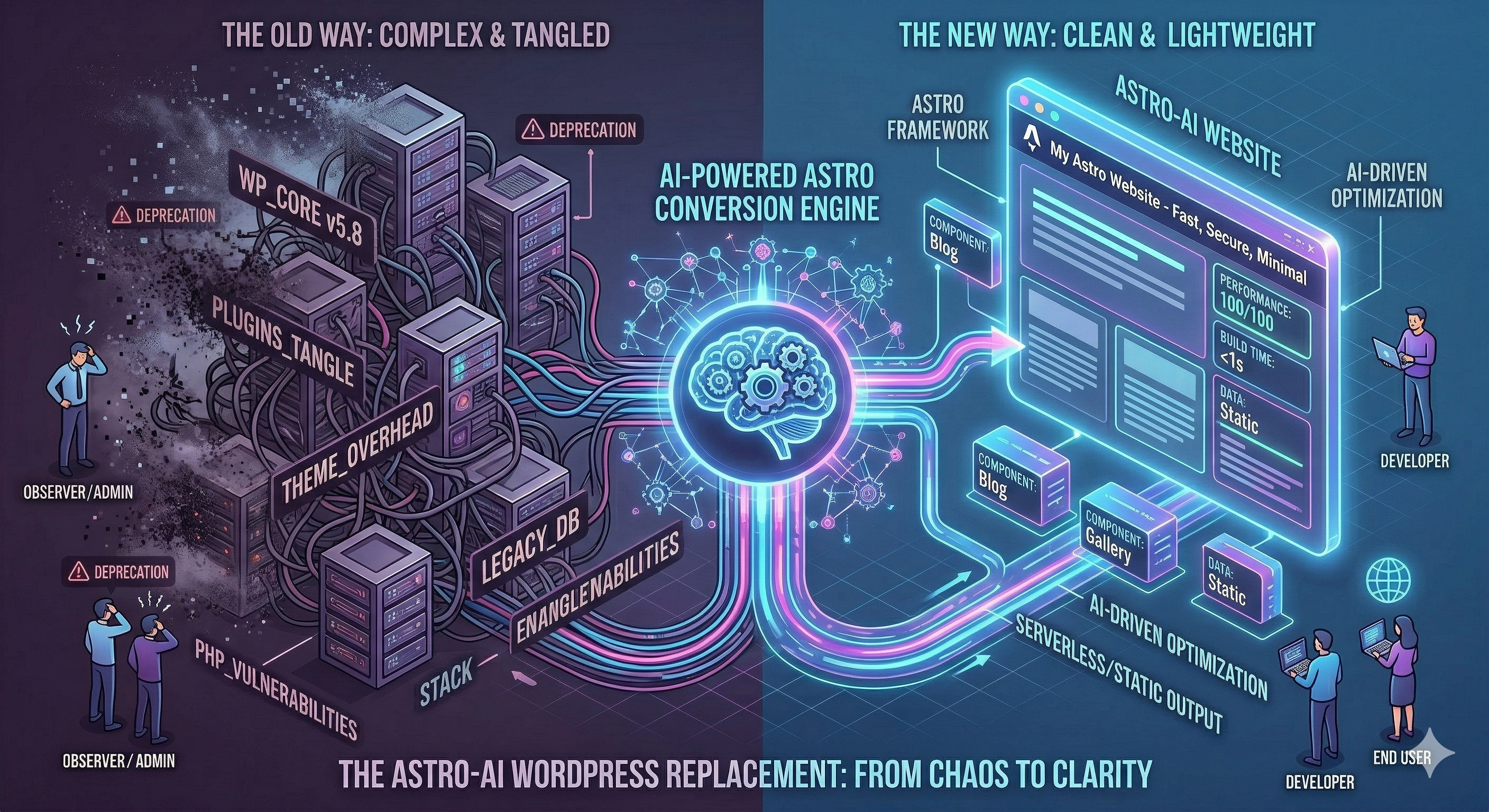
The result is better than WordPress in every measurable way - faster pages, no security patches, free hosting, no plugin conflicts, version-controlled content. The only thing you give up is the WordPress admin UI, and AI is rapidly making that trade feel like a good deal.
The frameworks worth knowing
Astro
Astro is the one I have been using lately and genuinely enjoying. It is a static site generator that ships zero JavaScript by default - pages are pure HTML and CSS unless you explicitly add interactivity. Content collections give you type-safe Markdown-based content management built in. Blog posts live as MDX files in your repo, no database required.
The developer experience is excellent and it plays extremely well with AI tools. Components are clean and readable, which means AI-generated code is easy to review and understand. This site is built with Astro.
For most marketing sites, portfolios and blogs, Astro is my current first recommendation.
Starlight
Starlight is Astro’s documentation framework and it deserves its own mention. If you are building a documentation site - for a product, an API, an open source project - Starlight is purpose-built for it. You get full-text search, versioning, a sidebar navigation system and i18n support out of the box. The output is fast, accessible and clean.
It is the framework I would reach for over GitBook or Notion for any serious documentation project.
Eleventy (11ty)
Eleventy is the minimalist pick. No framework opinions, no client-side JavaScript, just a build tool that turns templates and content into HTML. It has a reputation for stability and simplicity - the kind of tool that does not surprise you.
If you want full control and minimal abstraction, Eleventy is worth a serious look. It is particularly popular in the blog and personal site space where you want the output to be dead simple.
Hugo
Hugo is the speed pick. Written in Go, it can build thousands of pages in under a second. For large content sites - news, documentation with hundreds of pages, multilingual sites - Hugo’s build performance is unmatched.
The templating system has a steeper learning curve than Astro or Eleventy, but if build speed is a constraint, nothing beats it.
The practical comparison
| WordPress | Astro | Eleventy | Hugo | |
|---|---|---|---|---|
| Hosting cost | $10-30/mo | Free | Free | Free |
| Page load | 1-4s | 100-300ms | 100-300ms | 100-300ms |
| Security patches | Constant | None | None | None |
| AI-friendliness | Low | High | Medium | Medium |
| Best for | CMS-heavy | Most sites | Minimalists | Large sites |
When WordPress still makes sense
Astro and its peers are not the right answer for every site. WordPress still wins when:
- You have a large non-technical team that needs a full CMS workflow with approvals, scheduling and roles
- You are running WooCommerce with a complex product catalog
- Your site depends on plugins with no static equivalent - booking systems, membership portals, complex payment flows
For everything else - marketing sites, portfolios, blogs, documentation, landing pages - a static framework hosted on Cloudflare or Netlify is faster to build, cheaper to run and easier to maintain.
The shift happening right now
WordPress won the last era of the web by making sites accessible to everyone. The combination of AI coding tools and modern static frameworks is winning the next one by making that trade-off obsolete.
You no longer have to choose between a clean codebase and accessibility. You get both, for free, with pages that load instantly and zero server maintenance.
If your WordPress site is mostly static content, the migration is simpler than you think. Studio Cavan has done it for several sites and would be glad to help with yours.