Tags: seo, ai, content, marketing, search
Modern SEO in 2026: AI Tools, Answer Engines and What Actually Works
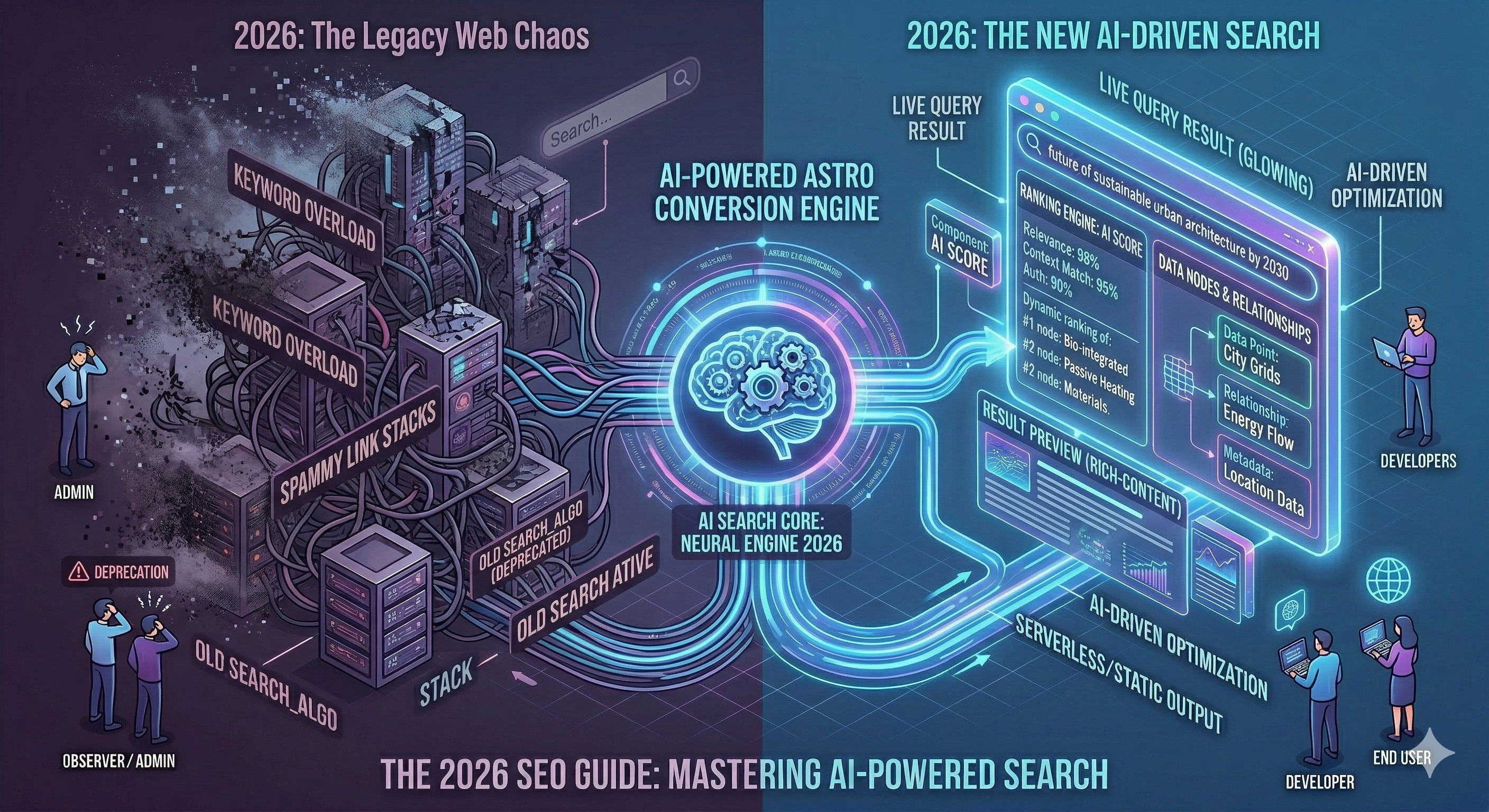
Search has changed more in the last two years than in the previous decade. Google’s AI Overviews now answer many queries directly on the results page. Perplexity and ChatGPT have become legitimate research tools that millions use instead of Google. And the content farms that gamed keyword rankings for years are getting wiped out by algorithm updates targeting AI-generated slop.
The rules have shifted. Here is what actually works in 2026.
The New Search Landscape
Before talking tools, you need to understand what you are optimizing for.
Google AI Overviews synthesize answers from multiple sources and display them above the traditional results. For informational queries, organic click-through rates have dropped significantly. The consolation: sites that are cited in AI Overviews often see brand exposure even without a click.
Perplexity and ChatGPT Search are pulling real search volume, particularly from technical and research-heavy audiences. These tools pull from the web but weight authoritative, well-structured content differently than Google.
Traditional search is not dead. Transactional queries - “buy X”, “best X for Y”, “X near me” - still drive enormous click volume. Local SEO and e-commerce SEO work largely the same as before. The disruption is concentrated in informational content.
The implication: content strategy in 2026 requires optimizing for both traditional search ranking and for being cited by AI answer engines. These goals overlap more than they conflict.
What is Working
Genuine expertise and specificity
Every major algorithm update in the last two years has rewarded demonstrated expertise and punished generic content. Google’s E-E-A-T (Experience, Expertise, Authoritativeness, Trustworthiness) framework is now central to how content is evaluated.
What this means practically: first-person experience, specific examples, data and opinions outperform neutral listicles. A post that says “I built this system and here is what I learned” will outrank a post that summarizes what everyone else says about the topic.
This is actually good news. AI tools make it easy to produce generic content at scale. Genuine expertise is the moat.
Long-form content with strong structure
AI answer engines prefer well-structured content with clear headings and logical flow. A 2,000-word post with good H2/H3 structure, a clear thesis and specific claims is far more likely to be cited than 500 words of vague advice.
Structured data (schema.org markup) helps Google and Perplexity understand your content’s context. Article schema, FAQ schema and HowTo schema are all worth adding to content pages.
Technical SEO still matters
Core Web Vitals scores are a direct ranking factor. Page speed, layout stability and interactivity all count. This is one of the reasons static sites built with Astro or Hugo have a natural advantage - they load fast without optimization effort.
For any serious SEO investment, the technical foundation should be solid before content is the priority.
The AI Tools Leading the Space
Surfer SEO
Surfer is the most widely used AI-assisted content optimization tool. It analyzes the top-ranking pages for a query and gives you a content score based on keyword usage, structure, word count and semantic coverage. The editor shows you in real time how your draft compares to competitors.
It is most useful in the drafting phase - less about research and more about closing the gap between your content and what is currently ranking.
Semrush
Semrush has evolved into a full AI-assisted SEO platform. Its keyword research, competitive analysis and site audit tools are industry standard. The newer AI writing and content brief features are solid, though the research tools remain its strongest asset.
For competitive intelligence - understanding what your competitors rank for, where they have gaps, and where you have an opportunity to win - Semrush is hard to beat.
Ahrefs
Ahrefs competes directly with Semrush and is preferred by many technical SEOs for its backlink data and site explorer. The keyword difficulty scores and SERP analysis are reliable. If you had to pick one research tool, the choice between Ahrefs and Semrush comes down to workflow preference - both are excellent.
Clearscope
Clearscope focuses specifically on content grading and semantic keyword coverage. It is cleaner and more focused than Surfer, and integrates directly with Google Docs and WordPress. Teams that publish high volumes of content tend to find the workflow integration valuable.
Frase
Frase is strong at the research and brief stage - it summarizes what the top-ranking pages cover so you can write something more comprehensive. The AI writing features are useful for scaffolding structure, though you will want to rewrite heavily for voice and accuracy.
Answer Engine Optimization (AEO)
The emerging concept alongside traditional SEO is AEO - optimizing to be cited by AI answer engines like Perplexity and ChatGPT Search.
The principles overlap heavily with good SEO:
- Clear, factual, specific claims
- Authoritative sources and citations within your content
- Structured content with logical headings
- Schema markup
- Strong domain authority from real backlinks
One additional factor: Perplexity and similar tools seem to weight recency more heavily than Google. Keeping cornerstone content updated with fresh data and dates is increasingly important.
What is Not Working
Keyword stuffing and thin content - Google’s Helpful Content system has made this reliably counterproductive. Content that exists purely to capture a keyword phrase without genuine depth is being deindexed at scale.
Exact-match anchor text link building - still a factor but highly gamed. Unnatural link profiles are now a liability more than an asset.
Publishing volume over quality - the content farm playbook of 50 mediocre posts per month has collapsed. Ten genuinely useful posts consistently outperform.
A Practical 2026 SEO Stack
For most content-driven sites, this combination covers the essential bases:
- Ahrefs or Semrush for keyword research and competitive analysis
- Surfer or Clearscope for content optimization during drafting
- Google Search Console for monitoring performance and catching issues - free and irreplaceable
- Screaming Frog for technical audits
- Schema markup via JSON-LD on all content pages
For content creation, AI tools like Claude are useful for drafting and structuring, but the expertise and specific examples need to come from real experience. The posts that are getting traction in 2026 read like they were written by someone who has actually done the thing, because they were.
Studio Cavan helps technical teams build content strategies that compound over time. Get in touch if SEO is on your roadmap.